
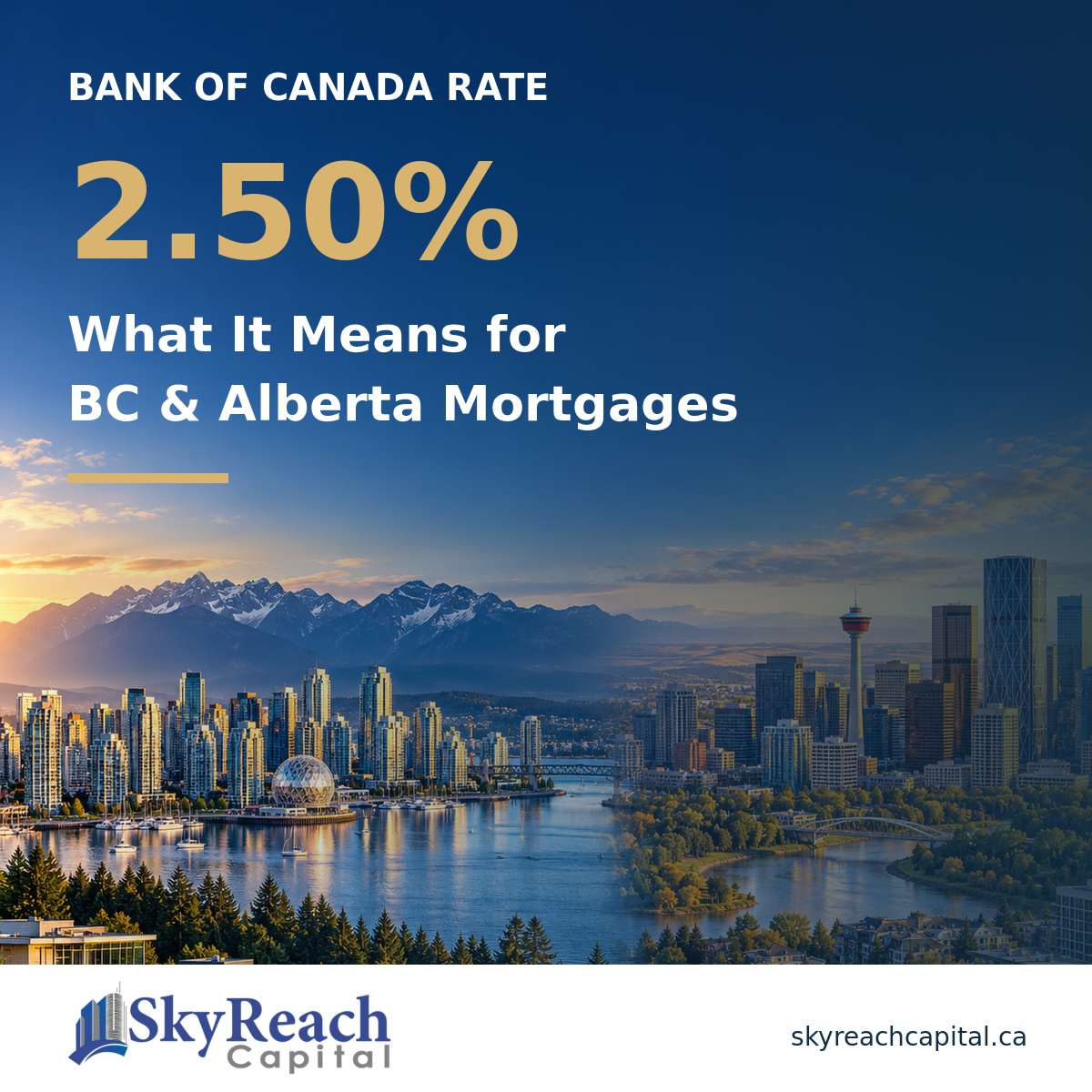
On October 28, 2026, the Bank of Canada increased its target for the overnight rate by 0.25 percentage points to 2.50%. The Bank Rate rose to 2.75%, while the deposit rate increased to 2.45%. The next scheduled interest-rate announcement is December 9, 2026.
The decision marks an important change for Canadian borrowers after the policy rate remained at 2.25% through most of 2026. For homeowners, real-estate investors, developers and businesses in British Columbia and Alberta, the immediate question is how this change may affect mortgage payments, qualification and access to financing.
The answer depends on the type of mortgage, lender, property and borrower.
Why did the Bank of Canada raise its rate?
The Bank said inflation had been around 3% since April and could reach approximately 3.5% by the end of 2026. Higher energy costs and the possibility that businesses will pass more of those costs to consumers contributed to the decision.
At the same time, the Bank reported stronger-than-expected economic growth through the middle of 2026. Canadian GDP grew at an annualized rate of 3.3% in the second quarter, although the economy is expected to slow in the fourth quarter amid trade uncertainty and new tariffs.
The Bank indicated that another increase could be necessary, but that future decisions would be made carefully. Borrowers should therefore avoid assuming that rates will either continue rising or quickly reverse.
Variable-rate mortgages and lines of credit
Variable mortgage rates and secured lines of credit are commonly priced using a lender’s prime rate plus or minus a contractual adjustment. When the overnight rate increases, lenders often adjust their prime rates, although the timing and size of each lender’s change is a commercial decision.
For borrowers with an adjustable-payment mortgage, an increase in the applicable rate can result in a higher payment. With certain fixed-payment variable mortgages, the payment may initially remain unchanged, but more of it can go toward interest and less toward principal. Depending on the contract, the lender may eventually require a payment adjustment.
Borrowers should review:
- Whether their mortgage has adjustable or fixed payments
- The current rate and discount or premium to prime
- Any trigger-rate or trigger-point provisions
- Prepayment privileges
- The cost of converting to a fixed-rate term
- The remaining amortization and renewal date
A rate increase does not automatically mean converting to a fixed rate is the best choice. The decision should reflect the borrower’s budget, time horizon, risk tolerance and mortgage terms.
Fixed mortgage rates may move differently
Fixed mortgage rates are influenced more directly by Government of Canada bond yields, funding costs and competition among lenders than by a single Bank of Canada announcement.
Bond markets often react before a policy decision. Consequently, fixed rates may rise, fall or remain stable even after the overnight rate changes. Borrowers comparing fixed and variable options should obtain current quotations rather than relying only on the headline policy rate.
The Financial Consumer Agency of Canada also reminds borrowers to consider whether they could continue making their payments if rates are higher when their mortgage renews.
BC and Alberta are not moving in lockstep
Regional conditions remain important. In Metro Vancouver, the composite residential benchmark price was approximately $1.076 million in September 2026. Sales remained slow, while inventory had begun trending lower.
CMHC expects British Columbia housing activity to remain below long-term averages, with affordability, employment conditions and a large supply of newly completed rental homes affecting the market. In the Prairies, housing activity has generally remained stronger relative to historical averages, although Calgary has experienced slower sales and more competition in some higher-density segments.
These differences matter when lenders assess property marketability, appraisal values, rental assumptions and exit strategies. A financing structure appropriate for a Vancouver condominium may not be suitable for a Calgary rental property, an Alberta commercial plaza or a BC construction project.
Where alternative and private lending may fit
Banks and other institutional lenders normally assess income, credit, debt-service ratios, property type and repayment history. A borrower may have substantial property equity but still fall outside conventional lending guidelines because of self-employment, credit issues, construction risk, a time-sensitive purchase or an unusual property.
Alternative or private lending may help in some of these situations. These loans are commonly underwritten with greater emphasis on property value, loan-to-value ratio, marketability and a credible repayment or exit strategy.
Private financing can involve higher interest rates than conventional mortgages, lender and brokerage fees, appraisal and legal costs, shorter terms, interest-only payments, renewal fees or no assurance of renewal, default charges and enforcement risk.
It should generally be treated as a structured financing solution—not an automatic substitute for affordable long-term financing. Before proceeding, borrowers should understand the annual percentage rate, total borrowing cost, payment obligations and realistic exit plan.
Mortgage borrowing and mortgage investing are different activities
A borrower receiving a mortgage is entering into a debt obligation secured against real property. An investor purchasing units of a mortgage fund or trust is acquiring an investment product whose performance may depend on a portfolio of mortgage loans.
Mortgage investment returns are not guaranteed. Important risks can include borrower default, changes in property values, appraisal uncertainty, mortgage priority, geographic or borrower concentration, enforcement costs, interest-rate changes and delays in selling properties following default.
Investors should review management and performance-related fees, portfolio loan-to-value and mortgage position, related-party transactions, valuation policies, redemption terms, available liquidity, the manager’s ability to suspend or defer redemptions, and the applicable offering document. Past performance does not predict future results, and a mortgage secured against real estate can still experience a loss.
Can mortgage investments be held in an RRSP or TFSA?
Some mortgage-related investments may be eligible for certain registered plans, but eligibility is not automatic.
CRA states that registered plans must hold qualified investments. Certain insured mortgages and some fully secured mortgages on Canadian real property may qualify when detailed conditions are satisfied. Units of a particular fund or trust may also qualify depending on its legal structure and status. Registered-plan trustees may impose additional restrictions beyond the tax rules.
Qualified-investment status must also be distinguished from the prohibited-investment rules. A plan holder’s significant interest—generally 10% or more when relevant non-arm’s-length holdings are included—or a non-arm’s-length relationship can create additional tax concerns.
CRA warns that acquiring a non-qualified investment can result in a tax equal to 50% of its value, subject to limited refund provisions, as well as tax on income earned by the plan. Investors should obtain confirmation from the registered-plan trustee and appropriate tax or legal advice before subscribing.
Plan before the next rate decision
The October rate increase makes advance planning more important. Borrowers approaching renewal should review their options early. Real-estate investors and developers should stress-test financing costs, timelines and exit assumptions. Prospective mortgage investors should evaluate risk, fees, liquidity and registered-account eligibility rather than focusing only on an expected return.
Sources
- Bank of Canada interest-rate decision — October 28, 2026
- Bank of Canada policy interest rate
- CMHC Housing Market Outlook 2026
- Greater Vancouver REALTORS® September 2026 market report
- CREB® September 2026 housing statistics
- CRA Income Tax Folio S3-F10-C1: Qualified Investments
- CRA guide to RRSPs and other registered plans
General-information disclaimer: This article is for general information only and does not constitute mortgage, investment, securities, legal, accounting or tax advice, an offer to sell securities, or a recommendation to borrow or invest. Mortgage approval, rates and terms are subject to lender criteria and change without notice. Investment products involve risk, may be illiquid, are not guaranteed or insured unless expressly stated, and may result in loss of principal. Registered-account eligibility depends on the specific investment, applicable law and the policies of the plan trustee. Prospective investors should review the relevant offering documents and consult qualified professional advisers.